

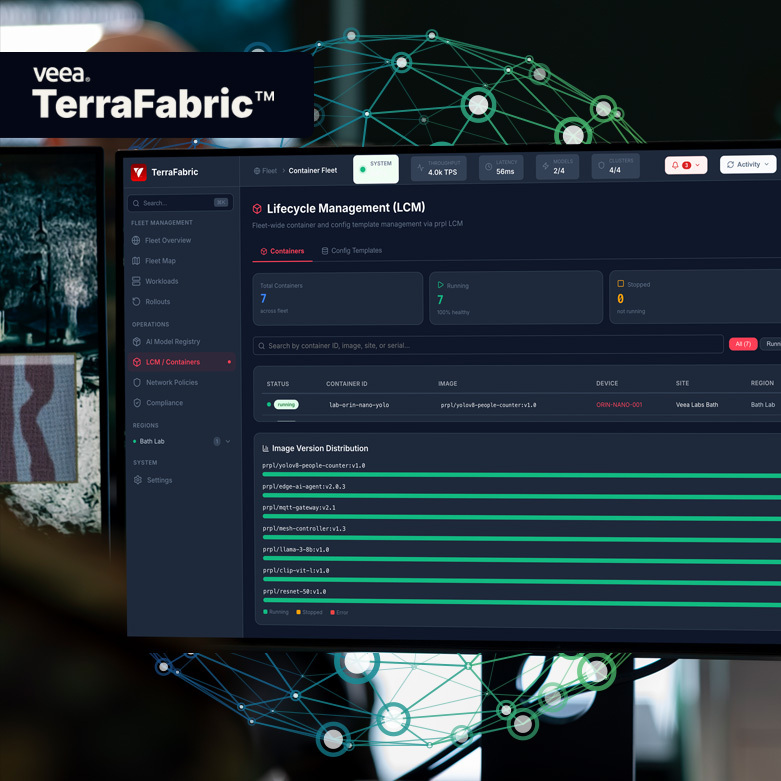


The conversations at Mobile World Congress 2026 made one thing clear. The industry conversation around AI infrastructure is shifting toward hyperconverged edge systems operating where data is created. That architecture closely mirrors what the VeeaONE platform is already delivering in market today.
For the past several years, most of the attention has been on centralized cloud infrastructure. Bigger GPU clusters. Larger data centers. More powerful training environments. That part of the story is real, but it is no longer the entire story. Increasingly, people are asking what happens when AI has to operate in the physical world, close to where data is actually generated.
That means factories. Hospitals. Warehouses. Construction sites. Retail stores. Branch locations. Transportation environments. Real places with real latency, data privacy, security, reliability, and operational constraints.

At MWC this year, that shift became more visible.
What stood out watching the discussion was how closely the architecture they described maps to what Veea already has in market.
In their wrap-up discussion, Dave Vellante and John Furrier described the emergence of what they called "mini AI factories" operating at the edge. They framed the architecture as a hyperconverged edge platform that combines compute, networking, storage, security, AI inference, and unified orchestration into a single operating environment.
That framing matters because it captures something the industry is beginning to recognize.
The edge is no longer just a connectivity layer.
It is becoming a real execution environment for AI.
"The edge is no longer just a connectivity layer. It is becoming a real execution environment for AI."
VeeaONE platform, with its full software stack platform, brings together edge compute with a virtualized software environment, secure multi-access connectivity, local AI execution, cloud management and orchestration, lifecycle management, policy control, and governance in a single highly integrated edge solution. VeeaWare, VeeaONE's portable middleware, manages the multi-vendor heterogeneous network of devices, including VeeaHub nodes at the edge, turns the multiaccess multi-protocol networking mesh into a compute mesh, instantiates applications, orchestrates the edge resources, connects hardware seamlessly, integrates AI effortlessly, and more.
In summary, VeeaONE platform provides the operating environment. TerraFabric extends that into orchestration and governance across distributed sites. Applications such as VeeaVision run on top of that stack to deliver real outcomes in physical environments. Lobster Trap extends governance further by introducing policy enforcement at the AI interaction layer. Third-party infrastructure enrolled into VeeaONE platform is managed as first-class citizens rather than treated as external components.
These are not isolated product ideas. They are parts of the same architecture.
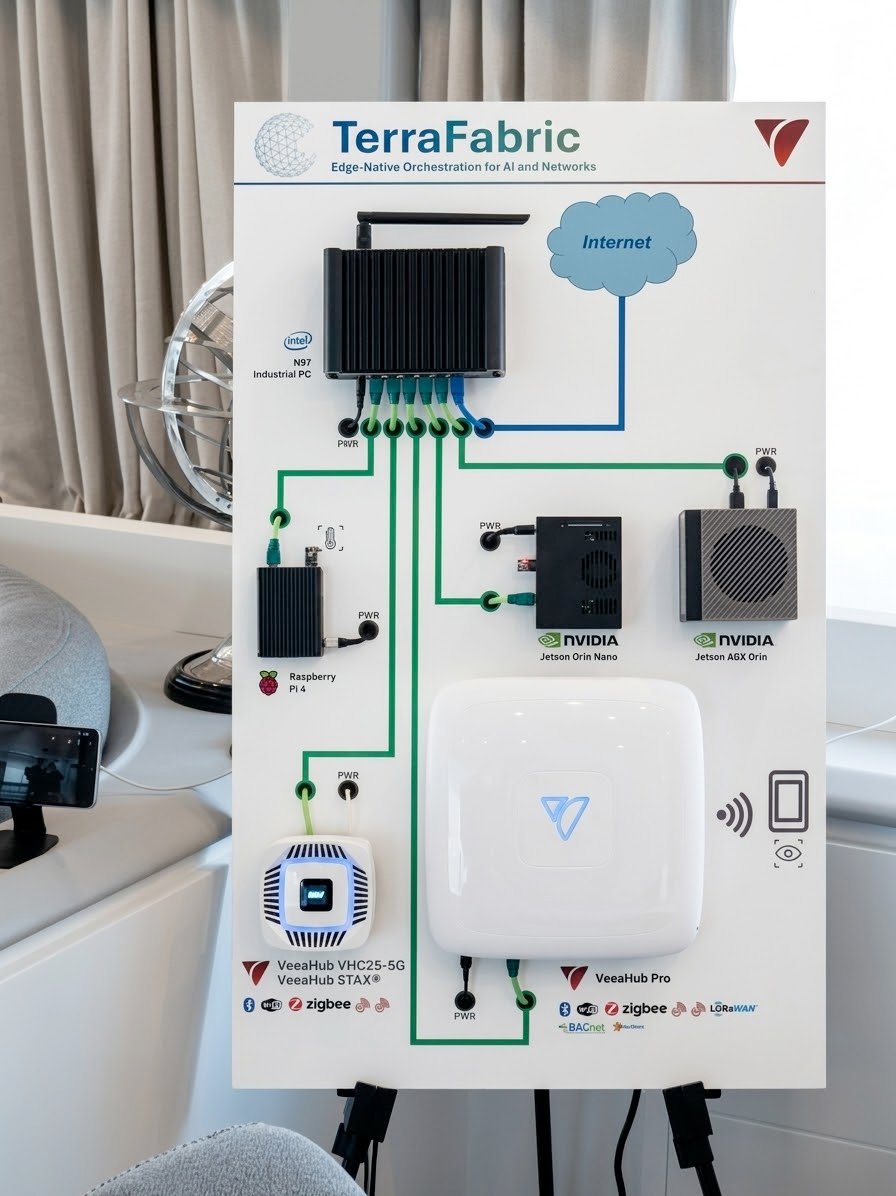
What we showed at MWC
At MWC, the hyperconverged architecture with Edge AI capability was on display in multiple forms demonstrating:
- Real-time AI inference running locally with VeeaVision
- IoT endpoint management across the networking and compute mesh
- Third-party hardware enrolled as first-class citizens in the VeeaONE platform
- Multi-WAN connectivity across 5G, fixed line, and satellite
- Secure managed connectivity for SMB deployments
- Distributed orchestration across edge environments with TerraFabric
That distinction matters.
There is a difference between talking about Edge AI as a future category and showing a platform where connectivity, security, orchestration, and local intelligence already operate together.
What we showed at MWC was not a collection of demos.
It was a working edge platform.
Telcel launch and market validation
The Telcel launch is a clear proof point.
 Operator proof point
Telcel SecureConnect is a live operator offer built on the VeeaONE platform
This is the market proof layer of the report: a major operator bringing managed connectivity, cybersecurity, and edge compute to SMBs as a real service, not a concept slide.

Not because it suddenly makes this architecture real but because it is being rolled-out at scale. The VeeaONE platform is already operating in multiple real-world deployments. América Móvil and Telcel have now brought VeeaONE platform to a much broader market.
What sets Telcel's launch of cybersecure 5G Fixed Wireless Access apart as a new product category is a business model designed to drive demonstrably higher ARPU through a suite of value-added services.
SecureConnect packages business connectivity, AI-driven cybersecurity, SD-WAN capabilities, Wi-Fi mesh, edge compute, and optional IoT and vision capabilities into a compact managed service designed for small and medium-sized businesses. It replaces the fragmented mix of modems, firewalls, servers, and bolt-on tools that many businesses still rely on today.
In practical terms, it is a live example of the hyperconverged edge architecture that industry thought leaders and analysts are beginning to describe.
And it demonstrates how that architecture can be delivered as a real operator service.
The platform layer
Another important point emerging from the conversations at MWC is where this architecture will take hold first.
The initial pull may not come from the slowest-moving parts of the telecom ecosystem. It is more likely to come from environments where the operational need is immediate. SMBs, such as pharmacies, clinics, QSRs and retailers, critical infrastructure, industrial sites, construction environments, logistics networks, and other physical systems where latency, privacy, reliability, security, and simple provisioning all matter at once.
That aligns with what we are already seeing.
The same VeeaONE platform that supports managed SMB connectivity and cybersecurity can also support real-time vision systems, IoT solutions, Edge AI processing, and distributed orchestration across fleets of locations.
Once viewed through that lens, the architecture stops looking like a collection of features and starts looking like what it actually is. An operating environment for distributed intelligence.
"The architecture stops looking like a collection of features and starts looking like an operating environment."
The role of TerraFabric
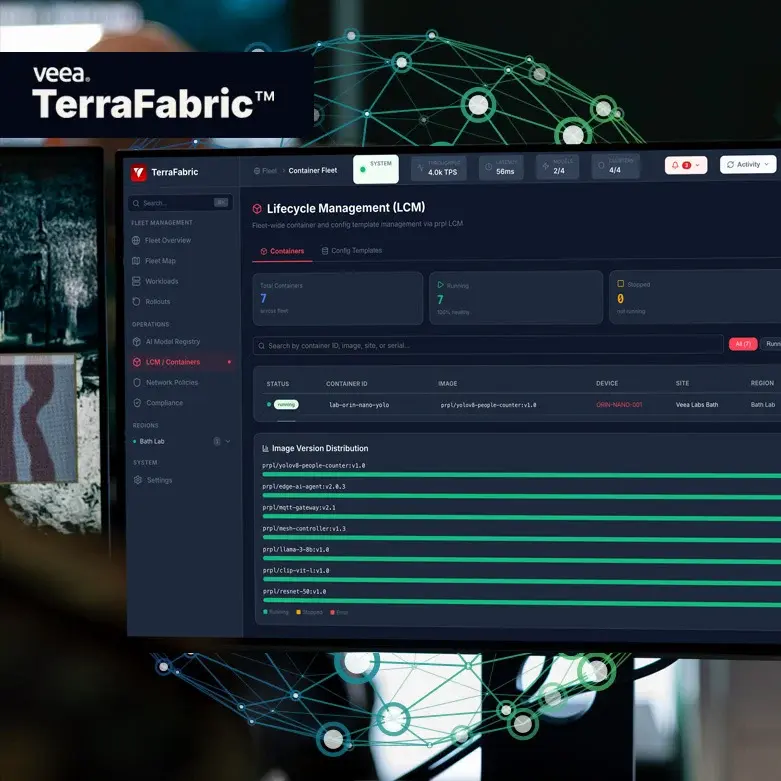
This is where TerraFabric becomes critical.
A single edge deployment is useful. A fleet of deployments introduces a different class of challenge. Coordinating software, policies, workloads, and AI behavior across hundreds or thousands of locations requires orchestration.
TerraFabric was introduced to address that layer.
It provides the governance and coordination framework that allows distributed edge environments to operate as a unified system rather than a collection of independent devices or networks.
That capability is what turns a set of edge nodes into a platform.
What comes next
The real story coming out of MWC is not that the industry discovered a new idea.
It is that the industry is starting to describe a new platform category and its architecture more clearly.
Once that architecture becomes visible, a number of pieces begin to make sense.
- The edge node is not just a box.
- The control plane is not just a dashboard.
- The AI workload is not just a model in the cloud.
- The network is not just transport.
Put together properly, these components form an operating environment.
That is where this is heading.
In several visible deployments today, it is already here.
Watch the industry discussion
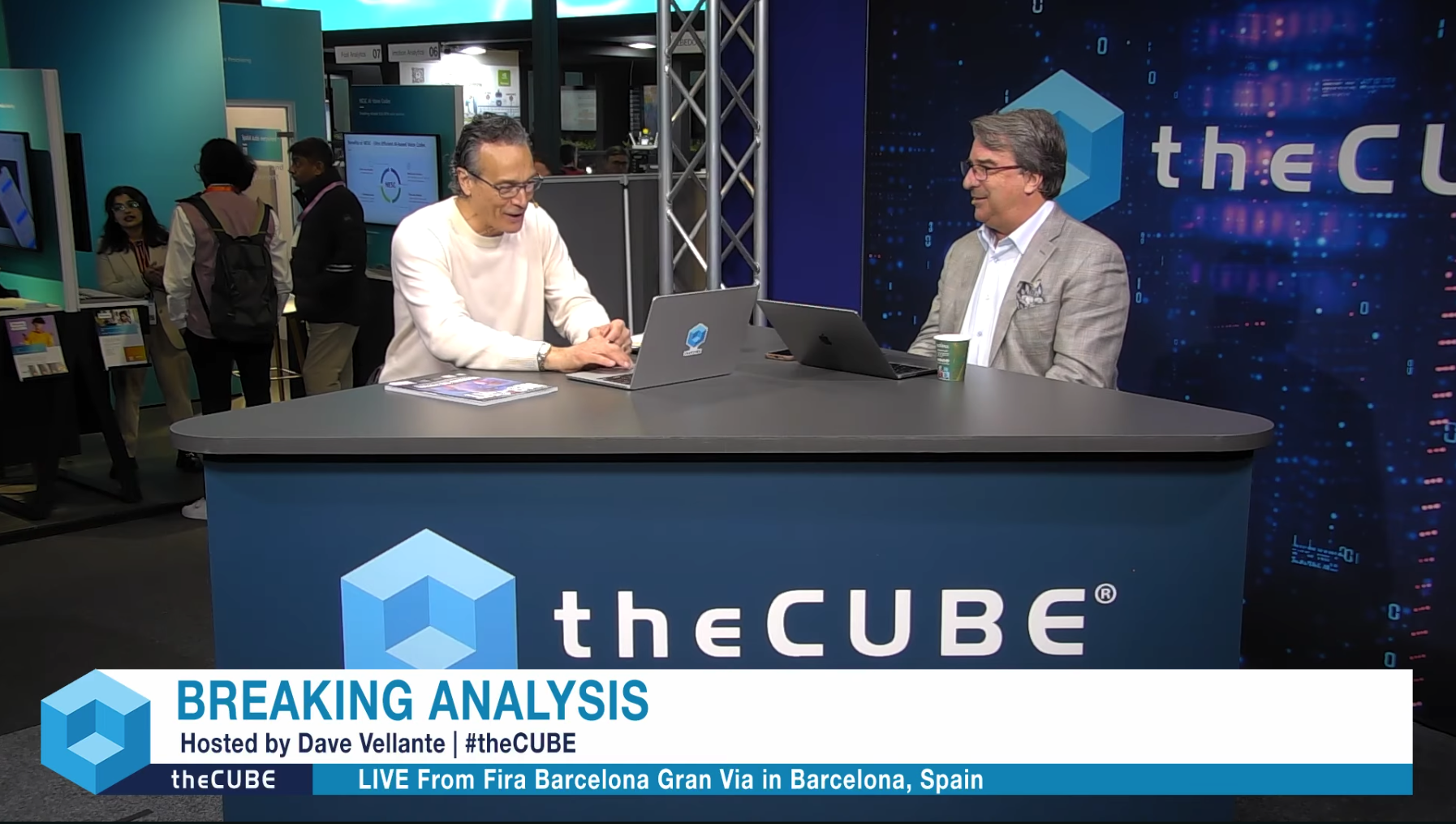
Watch industry thought leaders Dave Vellante and John Furrier reflect on the architectural shift emerging from Mobile World Congress 2026.