1. CV model rollout with failover
- Trigger
- New CV model version
- Action
- Roll out by region with health checks and failover
- Outcome
- Safe upgrade with rollback in one click
Why operators care: Protects uptime during model updates.
Scope: Region


VeeaONE powered by TerraFabric
The control plane for governed autonomous systems at the edge.
Edge infrastructure is no longer the problem. Operating it safely at scale is.
Early deployments now.
Built for operators. Designed for zero trust environments.
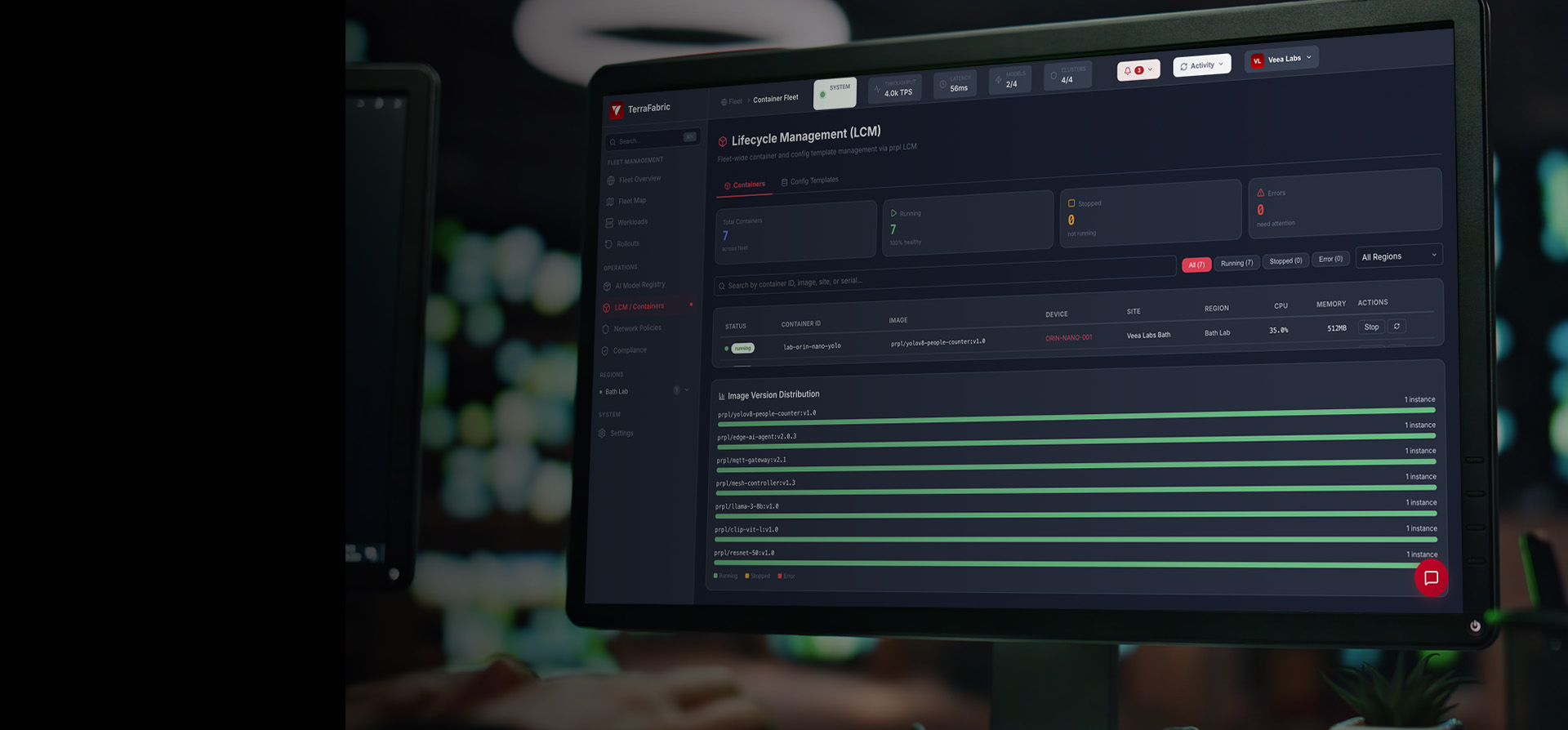
Most edge platforms stop at enrollment and container deployment. You can register a device, push a workload, and monitor basic health.
Once deployments become real, multiple sites, mixed hardware, AI workloads, and compliance requirements, device-level thinking breaks down.
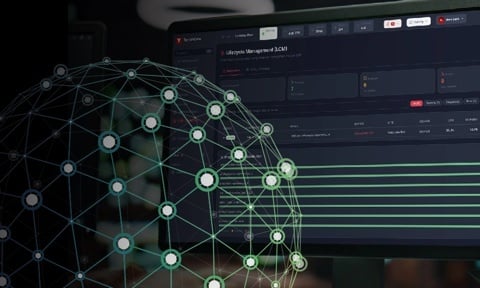
TerraFabric coordinates distributed edge environments as systems, not collections of devices. It brings fleet orchestration, policy enforcement, and controlled change management to heterogeneous, multi-vendor infrastructure you already run.
Operate distributed edge environments as highly coordinated systems.
TerraFabric does not replace Kubernetes. It does not replace your operating systems. It does not force a hardware model. It sits above them.
Instead of asking “Which device should run this container?” TerraFabric asks where a system should run, under what constraints, across which scope, and with what policy boundaries.
That is the difference between managing devices and operating systems.
x86, GPU nodes, Kubernetes clusters, distributed sites.
Policy, orchestration, topology, rollout sequencing, rollback.
Applications, agents, CV pipelines, automation workflows.
Some examples.
Why operators care: Protects uptime during model updates.
Scope: Region
Why operators care: Faster, safer event handling across sites.
Scope: Site / Region
Why operators care: Reduces drift and limits blast radius.
Scope: Region / Fleet
Why operators care: Change control without tooling sprawl.
Scope: Fleet
Deploy it standalone. Run it inside VeeaONE. Or bridge both.
Deploy as a self-hosted or managed control plane across data centers, edge clusters, x86 and GPU nodes, and Kubernetes where it exists.
Software lifecycle management is powered by prpl LCM, the industry’s most proven open-source container lifecycle engine.
No rip-and-replace required.
Available directly in Control Center. Enroll VeeaHubs and additional nodes in one action and activate orchestration, policy, and lifecycle control across the mesh.
Bridge VeeaONE and non-Veea environments under one TerraFabric control plane.
Infrastructure diversity should not prevent coordination.
If edge systems are going to act through automation or AI agents, they must operate within clear boundaries. TerraFabric enables governed autonomy by enforcing those boundaries as part of the control plane, not as an afterthought.
This is how you run autonomy without creating a security incident.
Least-privilege network boundaries by scope.
Execution paths bound to identity and role.
Explicit allowlists with deny-by-default patterns.
Action-linked logs for compliance and review.
Rollback and kill-switch capabilities.
WAN Health
99%
Latency
42ms
GPU Headroom
31%
Drift Detected
2Sites
Edge environments are physical environments. Power fluctuates. Connectivity varies. Hardware ages. TerraFabric normalizes physical, network, and workload telemetry into a shared language so orchestration decisions stay consistent everywhere.
Identity-scoped access and least-privilege boundaries.
Controls that apply cleanly at fleet, region, and site levels.
Change history tied to action and fast rollback paths.
Works with existing infrastructure and mixed environments.
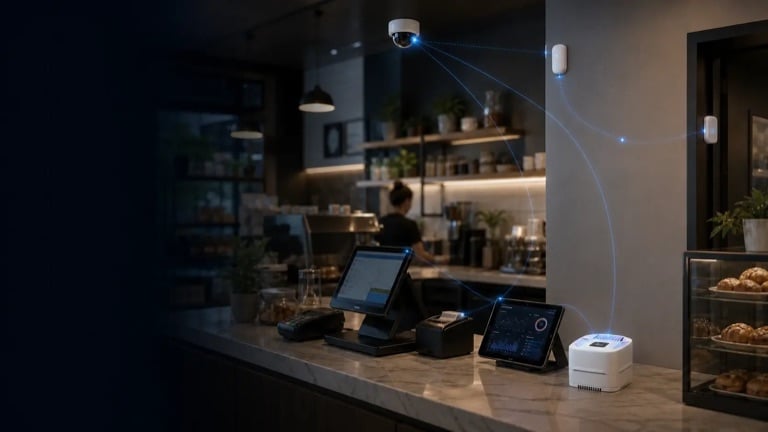
Connect, protect, and operate every business location.
Learn more
Bridging ecosystems, transforming spaces with edge-intelligent automation.
Learn more
Deliver managed enterprise security through a VeeaHub, without adding a separate security appliance at each site.
Learn more
Named deployments and what changed at each site.
Learn moreEarly Access
TerraFabric is in early deployments. If you want to evaluate it in your environment, talk to us.