

Get started with Veea

Tell us about your sites and what you want to run on them, and a Veea team member will follow up.

Prefer the full page? Go to Contact.

VeeaONE Platform™ · Core edge technologies

The hard part
isn't the box.

Putting compute at the edge is the easy part. Operating distributed systems securely across hardware targets, networks and sites is harder. VeeaONE brings application runtime, edge networking, device integration, fleet management and support for hardware-backed trust into one platform.
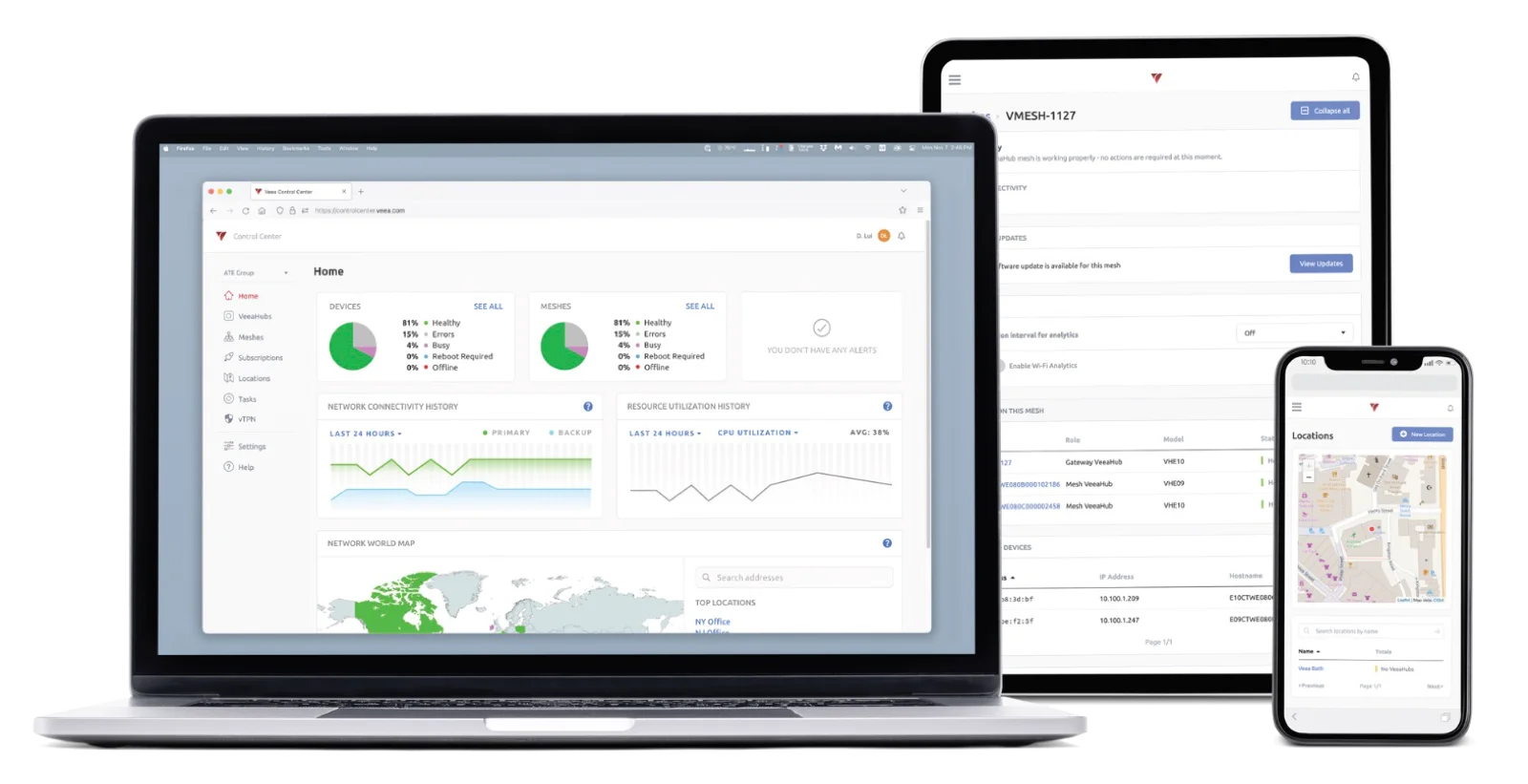

The Veea Control Center console on a laptop, tablet and phone, showing device health and network status.
An illustrated edge compute chip with a hardware trust boundary traced in gold over a circuit board.
  • Docker
  • Kubernetes
  • OAuth 2.0
  • OIDC
  • SAML
  • FoTA
  • eSIM
  • vSIM
  • Grafana
  • Secure boot
  • VLANs
  • MQTT
  • VeeaWare
  • vMesh
  • vBus
  • VeeaCloud
  • Control Center
  • VeeaHub Manager
  • Chain of trust
  • Hardware root of trust
  • Mesh analytics
  • Serverless
  • Containers
  • Multi-tenant
At a glance

The foundation of a managed edge platform

  • Applications, not fixed firmware

    Deploy signed containerized applications remotely across VeeaHubs and qualified edge systems, individually or across a fleet.

  • Compute where the work happens

    Select an edge system with the CPU, GPU, NPU, storage and connectivity the workload requires. Run analytics, automation and AI inference close to the devices and data they use.

  • Trust backed by hardware

    On supported targets, hardware-backed identity, secure boot and signed software help verify the system from startup through application deployment.

  • Fleet-wide operations

    Monitor system health, connectivity and application performance across distributed sites, with centralized alerts and management.

How it fits together

Six layers. One trust model.

VeeaONE brings edge hardware, application runtime, connectivity, device integration, cloud orchestration and operator tools into one platform. Trust and verification extend across the architecture, with available capabilities determined by the selected hardware target and deployment.

Control Center
& VeeaHub Manager
Control Center provides centralized fleet management. VeeaHub Manager supports local VeeaHub installation, diagnostics and configuration.
VeeaCloud Onboarding, application deployment, firmware management, policy, analytics and fleet visibility.
vMesh Connects VeeaHub nodes over wired and wireless links.
vBus Provides applications with a common way to discover and interact with connected equipment.
VeeaONE Runtime
& VeeaWare
VeeaONE Runtime provides a common execution layer across supported targets. On VeeaHubs, VeeaWare supplies native platform services, secure containers and distributed processing.
VeeaHubs and
qualified edge systems
VeeaHubs provide purpose-built connectivity and compute. Qualified systems support workloads with different compute, storage or acceleration requirements.
Chain of trust

Capabilities vary by hardware target and deployment configuration.

The difference

Integrated as a platform—or assembled component by component

Organizations can build an edge stack from individual technologies or add cloud device management to infrastructure they already operate. VeeaONE brings the runtime, connectivity, integration, trust and fleet-management layers together as a coordinated platform.

Roll your own Linux and parts Generic IoT cloud Manages what you built VeeaONE Platform™ Ships as one stack
Hardware-backed trust on supported targets No No
Secure boot and signed images on supported targets Partial No
Containers run on the device itself Partial Partial
VeeaHub mesh between nodes without a separate gateway No No
One API across mixed equipment No Partial
Fleet software and firmware management Partial Yes
Local applications can continue during an uplink interruption Partial No
One console for devices, apps and network No Partial
Cellular provisioning on supported configurations No Partial
Integrated platform support No Partial
Native Veea hardware

Connectivity and compute, together at the edge

VeeaHubs combine multi-protocol networking with local compute in a single edge system. Connected devices can send data to applications running locally, allowing the site to act immediately and forward only the information other systems need.

Connectivity, compute and acceleration capabilities vary by VeeaHub model and configuration.
What connects Wi-Fi Ethernet Bluetooth LE Zigbee & Thread LoRaWAN 4G/5G & satellite
A VeeaHub edge server VeeaHub radios + compute, one box
CPU GPU NPU NVMe
What runs locally
Containerized applications Container
Rules and automation Container
AI inference On device
Video analytics Container
Digital twins Container

Available workloads depend on the applications deployed and the resources of the selected VeeaHub.

Secure containers on VeeaWare · signed, isolated, updatable
What the site produces Local control actions Selected telemetry Application outputs vMesh traffic Cloud integrations Management events

VeeaHubs are native hardware targets for VeeaONE. When a workload requires a different compute, storage or acceleration profile, VeeaONE Runtime can also operate on qualified edge systems.

Security

Trust starts before the operating system.

On VeeaHubs, the chain of trust begins in hardware and extends through system startup, authenticated software images, container deployment and application access.

  1. Hardware-backed identity

    Each VeeaHub validates its bootloader against a cryptographic key programmed into the hardware. Device identity keys are hardware-protected, and hardware-level debugging interfaces are disabled.

  2. A verified startup process

    Only a trusted bootloader can run. The operating system and root file system must pass cryptographic verification before the system loads them.

  3. Isolated applications

    Applications run in isolated containers with limited system privileges. Application images must be digitally signed before they are accepted for distribution through the platform.

  4. A reduced attack surface

    Logins and internal debugging access are disabled by default. Unnecessary network services are not exposed, and firewall controls protect the services that remain.

Each stage verifies the next before control passes to it, creating a continuous chain from the hardware through the software running on the system.

Security capabilities on qualified third-party targets depend on the hardware and deployment configuration.

Before you decide

Technical questions before deployment

What continues during a cloud or uplink interruption?

Applications designed to operate locally can continue running on the edge system during a temporary interruption. On VeeaHubs, local mesh connectivity can also continue routing. Remote management and cloud-dependent services may be unavailable until connectivity returns. Available offline management functions depend on the deployment configuration.

How are updates managed across a large fleet?

Control Center supports remote firmware updates, application deployment and configuration management across VeeaHubs. Updates can be deployed in bulk or scheduled, while configuration tools help apply approved settings consistently. Update capabilities on qualified third-party targets vary by target and configuration.

Who can administer the platform?

VeeaCloud supports standards-based authentication, including OAuth 2.0, OIDC and SAML, along with single sign-on, role-based access and multi-tenant administration. Permissions can be scoped for installation teams, site operators and centralized IT. On VeeaHubs, direct device logins are disabled by default.

What can run on a VeeaHub?

VeeaHubs run signed containerized applications distributed through the platform. Workloads can include application services, automation, video analytics and local AI inference. Multiple applications can run in isolated containers, subject to the resources and capabilities of the selected model.

How do I connect equipment that does not use IP?

vBus provides an abstraction layer between applications and supported equipment interfaces. Applications can interact with capabilities through common APIs rather than managing every physical connection directly. Available protocols, drivers and connectors depend on the deployment, and some equipment may require additional integration.

How do I choose between a VeeaHub and another qualified system?

Start with the site environment, required connectivity and workload profile. VeeaHubs provide integrated networking and compute as native VeeaONE targets. Qualified systems can support workloads requiring different processors, storage or acceleration. Use the VeeaHub product brief and current datasheets for model-specific capabilities.

What are you trying to run at the edge?

Tell us where the workload needs to run, what equipment and data it uses, and which latency, connectivity and security constraints it must meet. We'll help identify the appropriate hardware target, platform capabilities and path to a first deployment.